87b0954f0c
Three things asked for, and a fourth found while doing them.

The map looked like a photograph of a map, and did so twice over.  The
window fetched at its own pixel size but for a box a third larger in each
direction -- the margin added to stop the ground blinking -- and then cut
the middle out, so every pixel was enlarged by two thirds.  It now asks
for enough pixels to cover the bigger box at the window's own detail.
Underneath that, both the window and the animation took the nearest source
pixel: the tile mosaic is commonly half again the size of the picture, so
most of every tile was thrown away and what survived was the aliasing.
Both now average the source pixels that fall in each output cell, done as
the difference of a running total rather than a loop.

An aircraft that goes quiet now fades instead of vanishing.  Taking it off
between one frame and the next says it stopped existing; fading says it
stopped talking, which is what happened.  It fades where it was last
actually seen and never along a reckoned track, because the reason for
giving up on it is that where it would be by now is a guess.  --fade sets
how long, and it is in the menu.  The window has alpha and fades smoothly;
an indexed picture cannot blend, so the animation gained a fourth ramp at
a seventh of full and fades in four steps, which at a second apart reads
as a fade.  A trail fades with the aircraft it belongs to, and the box
goes before the symbol does.

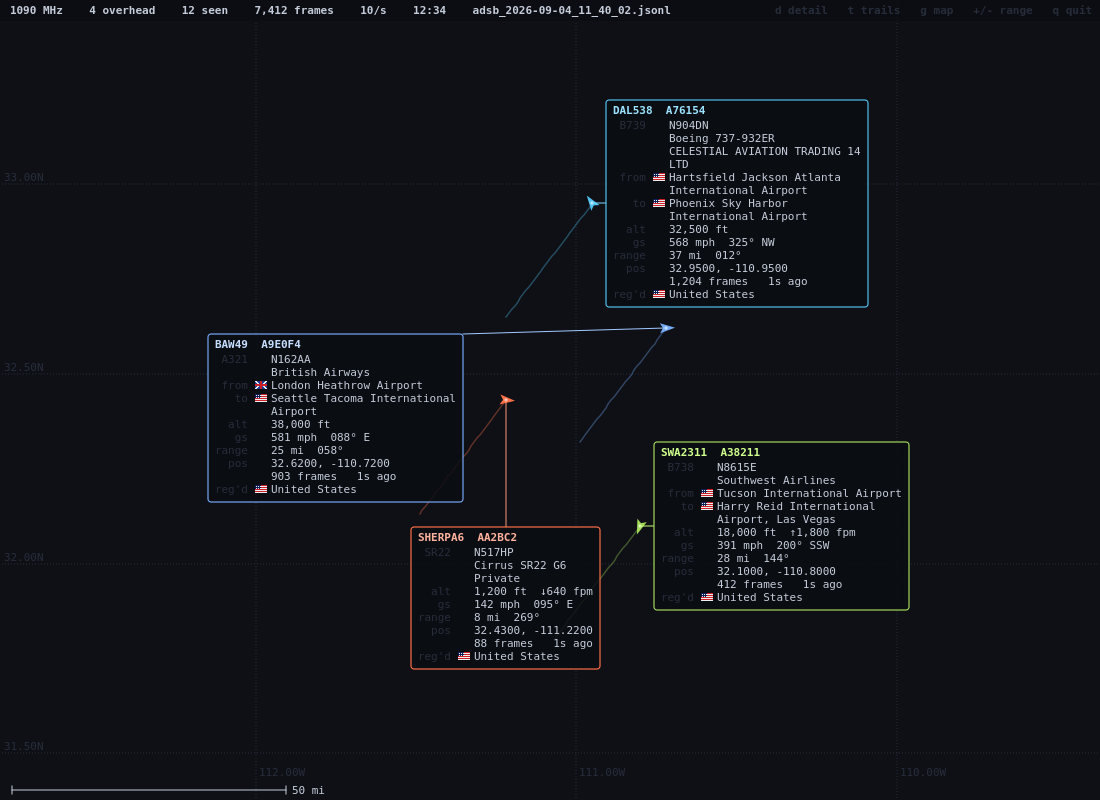
The aircraft's country of registration carries a flag now as well as the
two ends of its route, from the register where one answered and from the
address block otherwise.

And the fourth: the window's header counted an aircraft that had gone
quiet as overhead, which was saying more than had been heard.

Co-Authored-By: Claude Opus 5 <noreply@anthropic.com>
Claude-Session: https://claude.ai/code/session_016PsWPTweCT6pwxKngvVxcg
103 KiB
1100x800px
103 KiB
1100x800px